Course Summary
EDU 655 focused on the design and evaluation of educational assessments. The course examined how assessment decisions connect with instructional goals, learner performance, and the interpretation of results. Major topics included assessment planning, item writing, validity, reliability, scoring, and item analysis. Through a semester-long Instrument Construction Project, I worked through the process of defining a performance domain, developing a table of specifications, constructing assessment items, and considering how the resulting instrument could be administered and interpreted.
Selected Artifacts
ICP Item Bank
This item bank is a revised component of my Instrument Construction Project. I developed a 25-item assessment focused on understanding and applying the case-based method. The items included several response formats and were aligned with different learning outcomes and levels of cognitive demand. What made this artifact especially meaningful to me was the revision process. Feedback from classmates and the instructor led me to reconsider item wording, distractor quality, scoring criteria, alignment, cognitive demand, and assessment practicality. I documented the feedback, my responses, and the resulting revisions throughout the item bank.
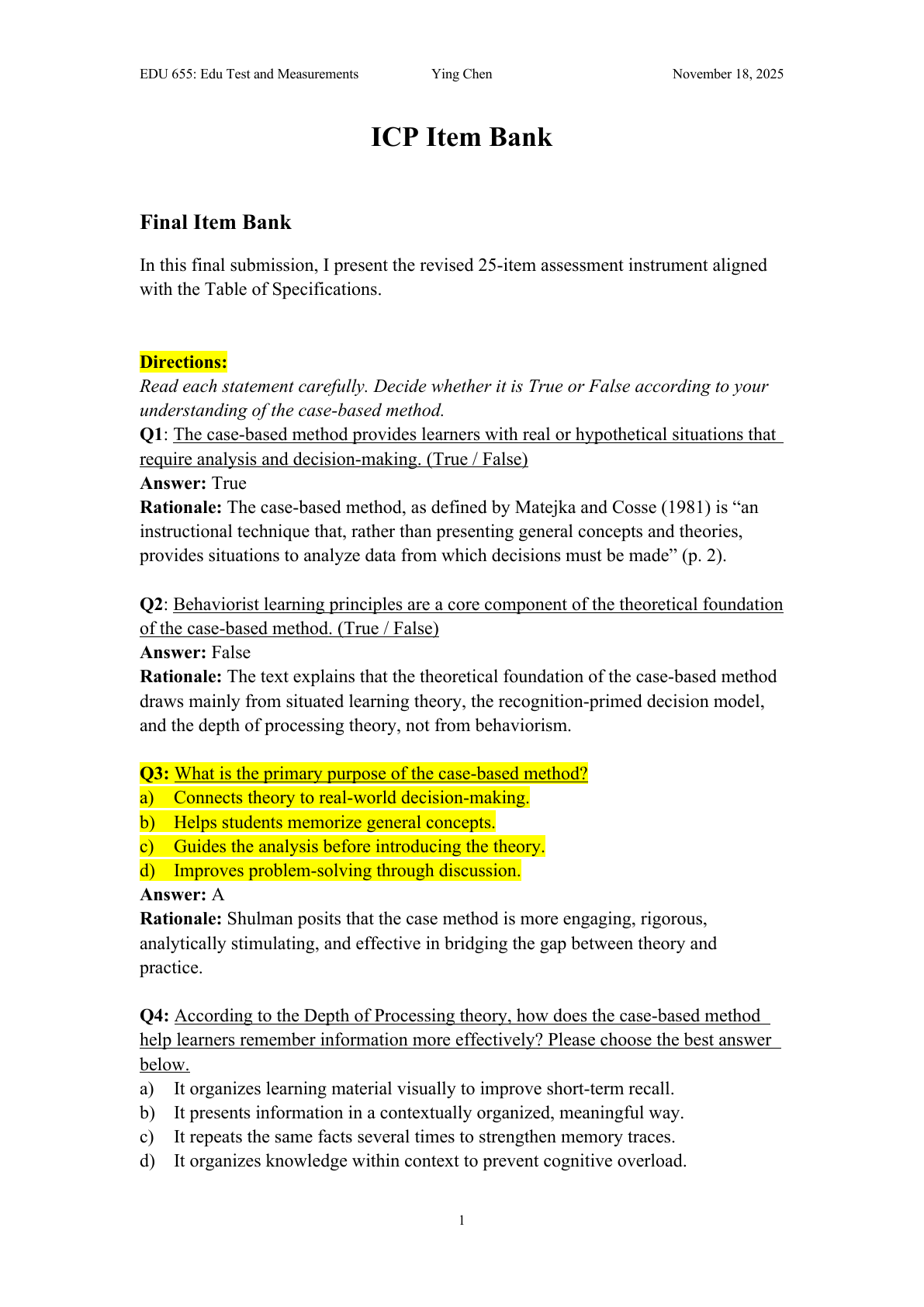
Please sign in with your Syracuse University account to view this document.
Reflection
This was the first time I had invested so much time and effort in developing and refining assessment items. The ICP Item Bank gave me the opportunity to examine each item much more closely. I wrote the items, received feedback from classmates and the instructor, and revised them several times. Some of the feedback pointed to problems I had not noticed myself. A question could look clear to me but still be interpreted differently by a student. A distractor could seem reasonable but fail to work as intended. I also learned to check whether each item actually matched the learning objective and the level of thinking I wanted to assess.
The revision process was the most meaningful part for me. It made me slow down and explain why I made each assessment decision. Reading other people’s feedback also helped me look at my own items from a different perspective. Sometimes I agreed with a suggestion and made a direct change. Other times, I needed to go back to the purpose of the item and decide whether a change was necessary. I began to see how small choices in wording, format, and scoring can affect what we learn from students’ responses. I also became more aware of the assumptions I bring into assessment design, especially when something seems clear simply because I wrote it myself. This experience has made me more careful when I design assessments and more willing to revisit choices that initially seem straightforward.