The Doctoral Plan
In the Doctoral Plan, you will find an overview of my academic progress through the doctoral program. The page includes my formal doctoral program plan and academic records, coursework completed at Syracuse University, Research Apprenticeship, and developing dissertation direction. Together, these sections show how my academic preparation has progressed and how it is beginning to inform the direction of my dissertation.
Use the “On this page” menu below to move between sections. You can return to the menu as you explore the page and select a section to go directly to the information you would like to view.
01
Formal Doctoral Program Plan & Academic Records
Status: Formal Doctoral Program Plan completed; pending review and approval.
This section includes my doctoral program plan, academic records, and related documentation that reflect my progress through the doctoral program.
Petition Form Doctoral program petition documentation. Document forthcoming
02
Doctoral Coursework at SU
The courses below trace my doctoral coursework at Syracuse University. Selected course pages include examples of my work and reflections on what I learned from the experience. Linked titles open the corresponding course pages.
CourseSemesterGrade
EDU 647 Statistical Thinking & ApplicationsFall 2024A
IDE 830 Design & Development Doctoral SeminarSpring 2025A
IDE 712 Analysis for Human Performance TechnologySpring 2025A
EDU 791 Advanced Seminar in Quantitative Research MethodsSpring 2025A
EDU 810 Advanced Seminar: Qualitative Research IFall 2025A
IDE 841 Design of InquiryFall 2025A
EDU 815 Advanced Seminar: Qualitative Research IISpring 2026A
MMI 680 AI for Media ProfessionalsSpring 2026A-
EDU 843 Pre-Dissertation SeminarFall 2026In progress
EDU 886 Multivariate Research MethodsFall 2026In progress
03
Research Apprenticeship (RAP)
RAP Documentation
Scholarly Outcomes
This Research Apprenticeship resulted in a conference presentation and a peer-reviewed publication. The study was presented at the 2026 AERA Annual Meeting and later published in Online Learning. The two outcomes are included below.
AERA Annual Meeting 2026
Instructional design students’ intention to use AI tools in ID practices
Chen, Y. [presenting author], & Cho, M.-H. (2026). Instructional design students’ intention to use AI tools in ID practices. Roundtable presentation at the American Educational Research Association (AERA) Annual Meeting, Los Angeles, CA.
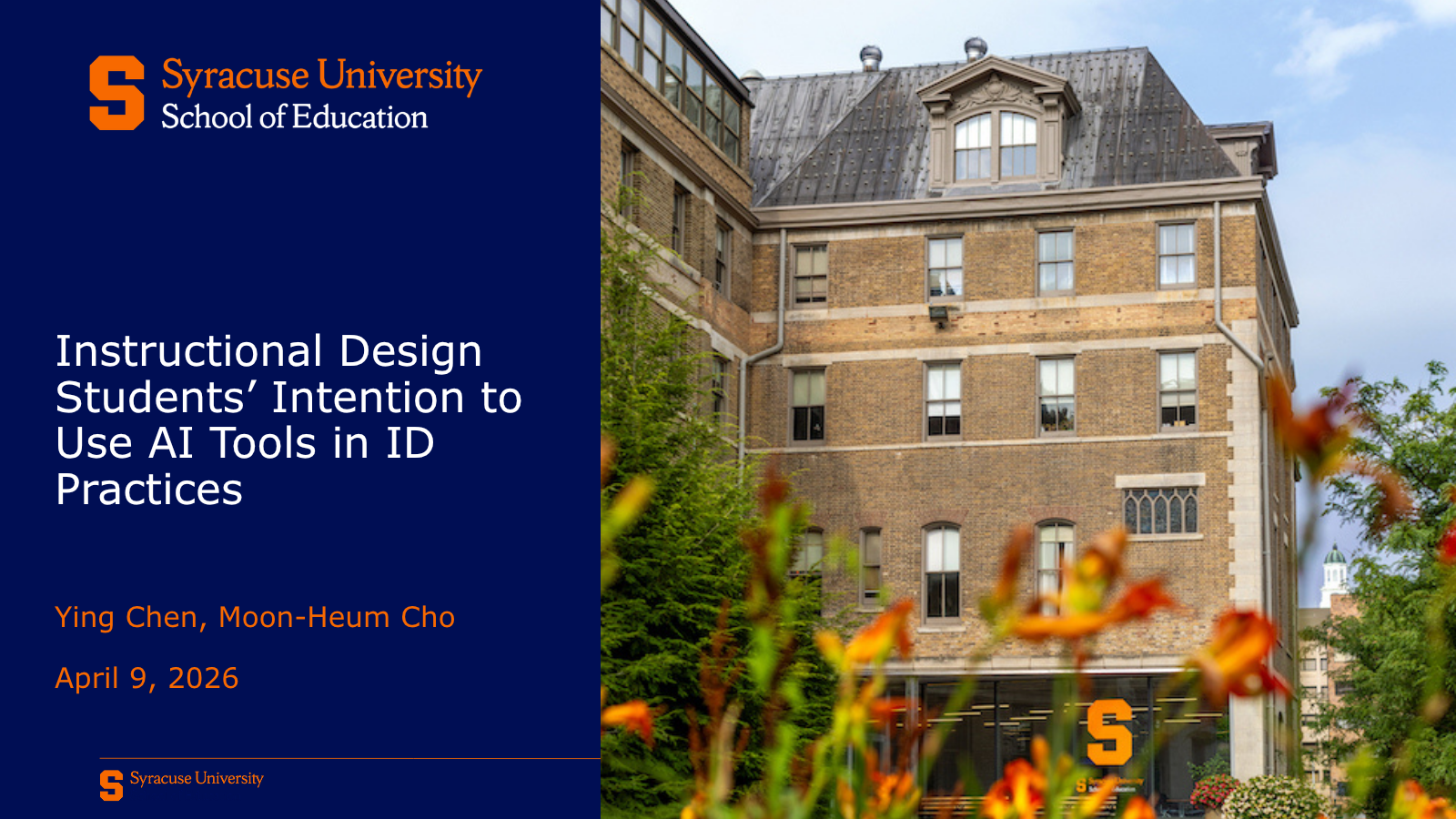 View presentation slides ↗Please sign in with your Syracuse University account to view this document.
Predicting Online Instructional Design Students’ Intention to Use AI Tools: Value, Utility, and Self-Efficacy
Cho, M.-H.*, & Chen, Y. (2026). Predicting online instructional design students’ intention to use AI tools: Value, utility, and self-efficacy. Online Learning, 30(2), 130–152.
View published article ↗Reflection
I started working on this Research Apprenticeship with the data analysis. I worked with regression analysis, cluster analysis, and content analysis, and this was one of my first opportunities at Syracuse to use several forms of analysis within the same study. Working on the analyses also gave me many opportunities to discuss the results with my faculty supervisor. We talked about what we were seeing in the data, how different results related to each other, and how they could be presented in the study. I found these conversations especially helpful because I could compare my own understanding of the results with my supervisor’s interpretation and go back to the data when I had questions.
I stayed with this project from data analysis through conference presentation and publication. This was especially meaningful to me because I was still becoming familiar with academic research in the U.S. I presented the study at the 2026 AERA Annual Meeting and later continued working on the manuscript and revisions. Through the same project, I was able to experience how research was prepared for a conference and then developed into a journal article. I also worked through reviewer comments and saw how the manuscript changed during revision. Following the project through these stages helped me become much more familiar with the conference and publication process in the U.S.
04
Dissertation Direction
My dissertation topic is still developing. I am currently interested in AI-supported online case-based learning and how AI, instructors, and peers contribute differently to the learning experience. As generative AI becomes more capable of providing explanations, feedback, ideas, and conversational support, I have become increasingly interested in what these capabilities mean for people's roles in a learning environment. What can AI appropriately support? What do students still expect from their instructors and peers? What kinds of participation continue to feel meaningfully human? These questions are becoming central to the direction I plan to pursue in my dissertation.
This interest grew from my previous research on AI-supported learning. I saw that students’ experiences were affected by more than the AI tool itself. Frustration could come from the technology, the instructional environment, or interactions with others. I also noticed some fatigue with AI-generated contributions. These findings made me think more carefully about what happens when AI becomes another active source of explanation, feedback, and ideas in a course. I am especially interested in how these changing interactions may affect students’ autonomy, competence, and relatedness, and how students understand the roles of AI, instructors, and peers within the same learning environment.
My Research Apprenticeship also shaped how I am approaching this direction. In the RAP project, I worked with regression analysis, cluster analysis, and content analysis to examine the same research problem from different angles. The experience made me more attentive to differences among learners. It also helped me think more carefully about the relationship between a research question, the evidence needed to answer it, and the analytical approach used to interpret that evidence. I want to carry this way of thinking into my dissertation. I may use multiple forms of data to understand different patterns of AI-supported learning, while allowing the specific research questions to determine the final methodology.
I currently plan to examine these questions in a Chinese university context. In the settings I hope to study, one instructor may be responsible for many students, causing sustained individual support difficult. This creates a useful context for asking what AI can support at scale and what students still need from instructors and peers. Conducting the study in China will also make it more feasible for me to reach a sufficiently large student population for survey data and following analysis. My specific research questions and methodology are still being refined. As the dissertation develops, I hope to better understand how AI and human support can work together in online case-based learning and how different forms of support shape students’ learning experiences.