Course Summary
IDE 611 explores the design, use, and evaluation of emerging technologies in educational settings. Through a series of module-based projects, the course provided hands-on experience with technologies including online learning platforms, gamification, immersive learning, artificial intelligence, makerspaces, and robotics. The course emphasized not only learning about emerging technologies, but also evaluating their appropriateness and applying them meaningfully in formal and informal learning environments.
Selected Artifacts
Makerspace Exploration & 3D-Printed Learning Model
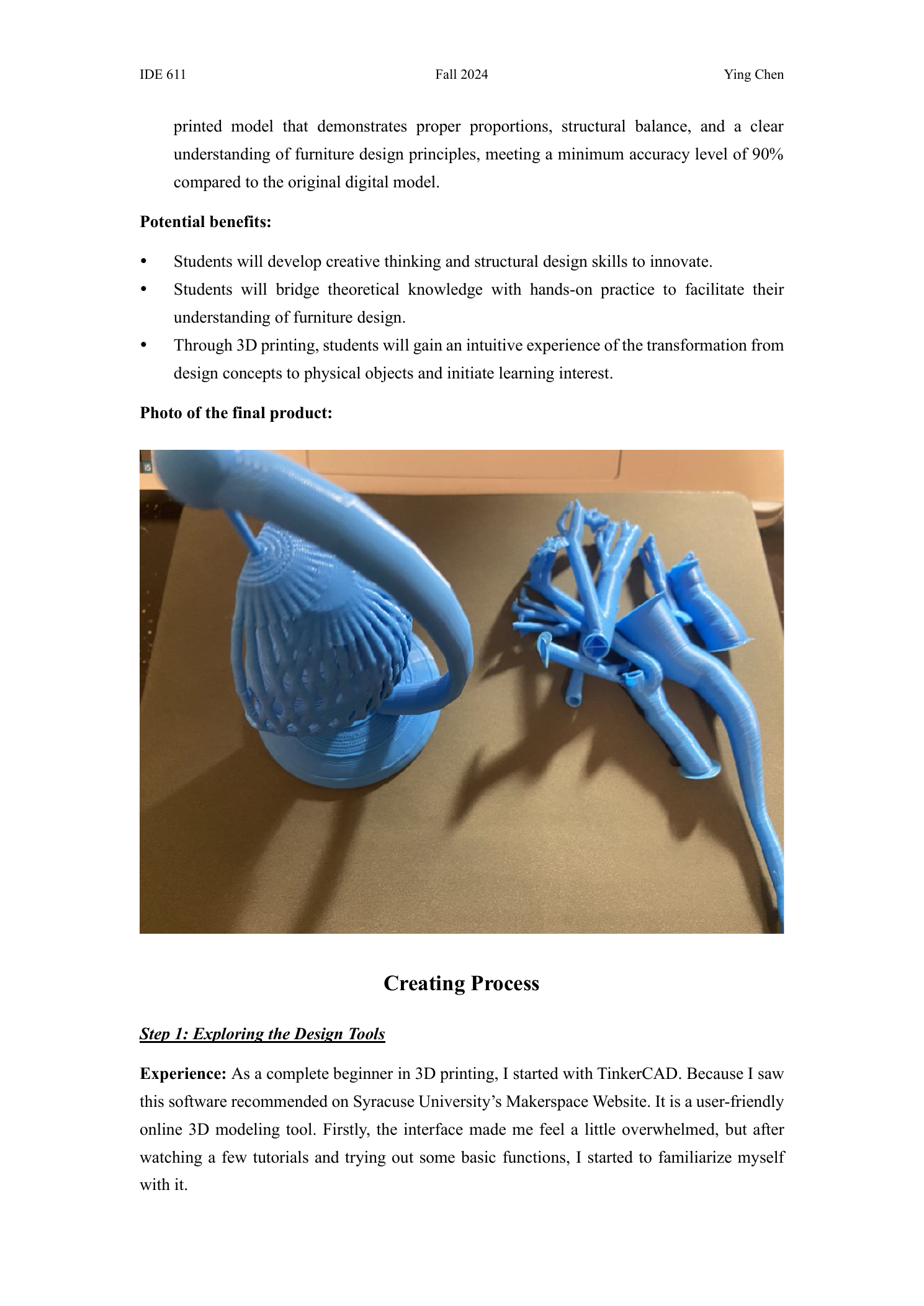
For the Makerspace module, I explored the Kimmel Makerspace and designed a 3D-printed hanging chair model using TinkerCAD. The project documented the Makerspace environment, the design and printing process, challenges encountered during development, and potential ways Makerspaces can support teaching and learning. The model was designed as an example of how a tangible artifact can help connect abstract furniture design principles with hands-on learning.
Please sign in with your Syracuse University account to view this document.
Reflection
One thing I became more attentive to in IDE 611 was the amount of judgment involved in choosing educational technologies. With so many tools available, it can be easy to focus on what a technology can do or how it might make an activity more engaging. During the course, I started looking more carefully at what happens when a particular tool is actually introduced into a learning activity. Different tools bring different possibilities, but they can also change what learners need to learn, prepare, and manage before they can complete the activity. I became more interested in thinking through these practical differences and comparing possible approaches before deciding what technology would make sense in a particular setting.
The 3D-printing project gave me a chance to think about this in a more concrete way. I had not used TinkerCAD before, so I learned the tool as we developed the project. As I worked with it, I became more aware of the preparation involved, the time needed to become comfortable with the tool, and the kinds of activities it could support well. I also thought about other ways we could design the same activity and whether using 3D printing added something that those alternatives could not provide. These are questions I still find useful when I work with educational technologies.