Course Summary
IST 736 introduced text mining as both a set of computational techniques and a research method for examining real-world text data. The course covered text representation, unsupervised and supervised modeling, deep learning and embeddings, large language models, and related approaches to text analysis. Through assignments and a final project, I learned to translate research questions into text-mining tasks, develop and evaluate analytical workflows in Python, interpret results critically, and communicate findings to different audiences.
Selected Artifacts
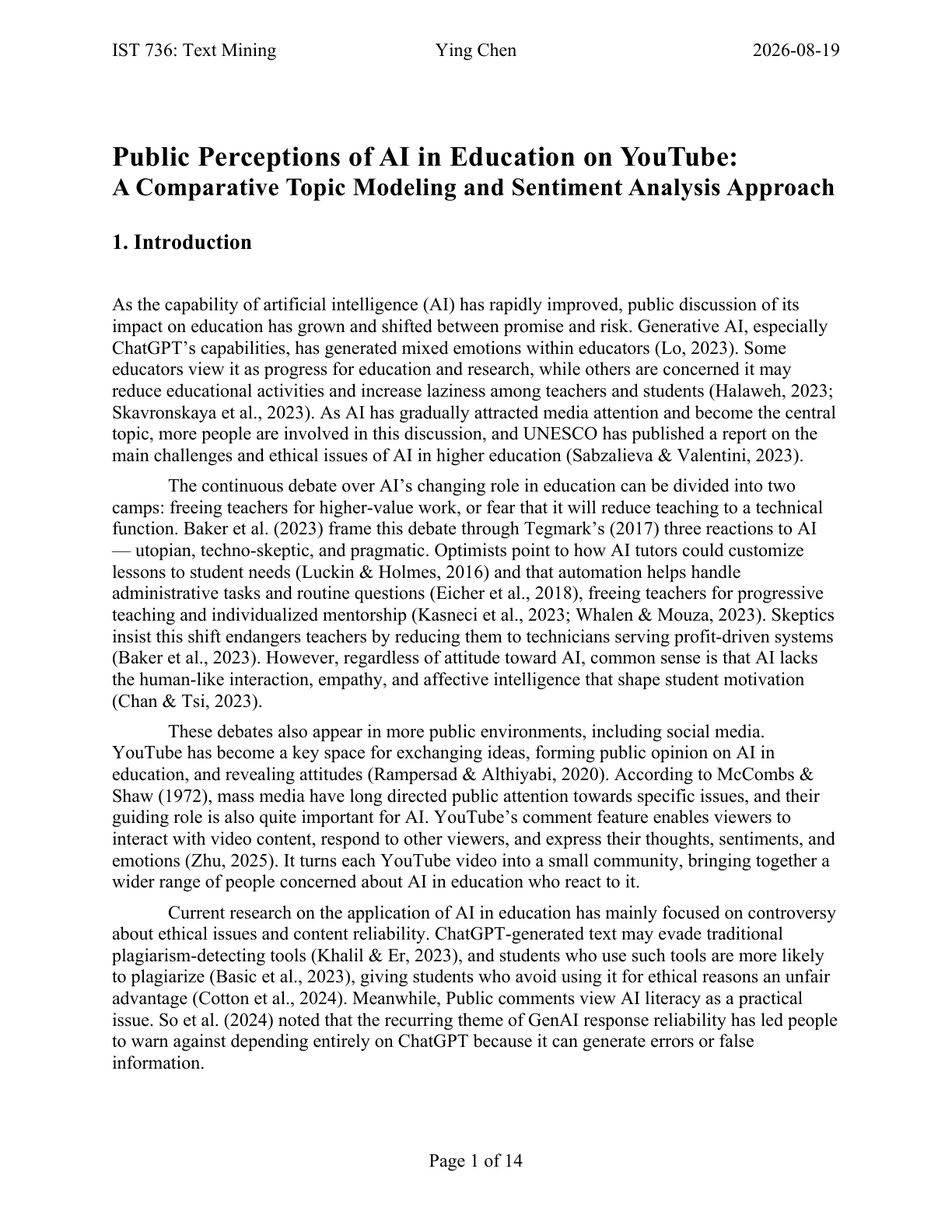
Public Perceptions of AI in Education on YouTube: A Comparative Topic Modeling and Sentiment Analysis Approach
This final project examined 7,796 public comments from 26 YouTube videos to investigate themes and sentiment in public discussions of AI in education. The analysis compared LDA with BERTopic for topic modeling and VADER with a pretrained Twitter-RoBERTa model for sentiment classification, including human validation and cross-model robustness checks. The report demonstrates my ability to build, evaluate, and critically interpret a complete Python-based text-mining workflow using real-world social-media data.
Please sign in with your Syracuse University account to view this document.
Reflection
IST 736 introduced me to another way of conducting research in education. I entered the course with almost no Python experience, so I first used online tutorials, examples, and repeated practice to build the basic skills I needed. As I became more comfortable with the technical side, I became more interested in how text mining was actually being used as a research method. To develop an initial understanding, I searched, read, and analyzed recent publications from top-tier journals in education. I paid particular attention to the connections among research questions, analytical techniques, results, and interpretation. I noticed that studies addressing similar research questions sometimes used different analytical approaches. This led me to ask the instructor how researchers decide which technique is appropriate for a particular study. That question helped me think more carefully about why an analytical method fits a research question and what its results allow us to conclude.
I explored these questions more directly through the final project. I used Codex to help develop and check code, tried different text-mining techniques, and conducted human validation. At each step, I needed to understand what the analysis was doing, examine whether the results made sense, and decide how the output should be interpreted. Working through the complete process gave me a much more concrete understanding of computational research. By the end of the course, I had gained an initial understanding of text mining as a research approach and added another methodological perspective to how I think about educational research.